
Comprehensive School Health
Comprehensive School Health (CSH) is a way to link health and education within the school setting. It is an internationally-recognized framework for building a healthy school community by supporting improvements in students' educational outcomes while addressing school health in a planned, integrated and holistic way. (Joint Consortium for School Health)
This page outlines what CSH is and how it relates to the Canadian Healthy School Standards, developed by the Canadian Healthy Schools Alliance (more on this below).
Please note that we do not control the content of or maintain these links. Should you come across a broken link or incorrect content, click here to let us know.
The whole-school model of CSH builds capacity to incorporate well-being as an essential aspect of student achievement. Actions address four distinct but inter-related components that comprise a comprehensive school health framework (Joint Consortium for School Health):
Teaching and Learning
Teaching and learning encompasses formal and informal curriculum, resources and associated activities. It means the knowledge, understanding and skills for school communities to improve their health and enhance learning outcomes. Professional Development opportunities for staff related to health and well-being would fall under this component.
Social and Physical Environment
The social environment is the quality of the relationships among and between staff and students.
The physical environment is the buildings, grounds, play space and equipment both in and surrounding the school. The physical environment should be safe, accessible and supportive of healthy choices.
Partnership and Services
In a CSH context, partnerships and services are supportive working relationships with other community organizations. It includes health, education and other sectors working together to advance health; as well as community and school-based services that support health and wellness for all.
Policy
Policy means the policies, guidelines and practices that promote and support student well-being and achievement, and shape a respectful, welcoming and caring school environment for all members of the school community.
When actions in all four components are harmonized, students are supported to realize their full potential as learners — and as healthy, productive members of society. (Joint Consortium for School Health)
Currently in Alberta, three key priority areas for CSH have been identified:
- Active Living
- Healthy Eating
- Mental Well-being
Other priority areas could include staff wellness, student leadership, injury prevention, growth and development, substance use, equity, diversity and inclusion and reconciliation.
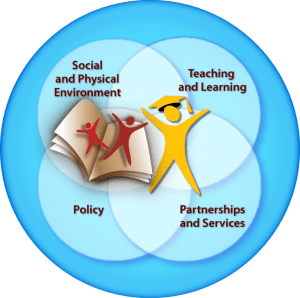
Effective, sustainable progress in CSH depends on a common vision, shared responsibilities and harmonized actions among health, education and other sectors. The challenge is to coordinate these efforts so that partners pool resources and develop action plans together, with and in support of schools. This is known as the CSH Process.
Resources to Support the CSH Process
- Steps for Building Healthy School Communities (Alberta Health Services) — This website houses tools, templates and resources to support you in going through the six step comprehensive school health process: prepare; create a shared vision; determine priority issues; develop an action plan; implement and monitor; and reflect, evaluate and celebrate.
- Healthy School Planner Tool (Pan-Canadian Joint Consortium for School Health (JCSH)) — Online tool to help schools create healthier environments. It offers a way to assess the overall environment as well as the option to focus on specific topics such as healthy eating, active living, tobacco or mental well-being. Includes recommendations and links to resources.
Comprehensive School Health recognizes that healthy students learn better and achieve more. It understands that schools can directly influence students' health and behaviours; encourages healthy lifestyle choices by promoting student health and well-being; and incorporates health into all aspects of school and learning.
CSH needs the participation and support of families and the community at large.
The Healthy Schools Certification can support your school community to implement the CSH process and meet the Canadian Healthy School Standards (below). This certification gives your school the tools to promote and enhance the health and well-being of students, school staff and the broader school community, guided by the following goals:
- To support schools that want to enhance the health and well-being of their students and staff
- To increase student engagement and leadership opportunities to support health and well-being at school
- To increase adult engagement in prioritizing health and well-being at school
- To strengthen community engagement and partnerships
Learn more about the Healthy Schools Certification and register your school here.
Canadian Healthy School Standards
The Canadian Healthy Schools Alliance launched the Canadian Healthy School Standards (the Standards) and subsequent toolkit for school system leaders in 2021. The Standards aim to spark conversations and be a tipping point where the school community comes together in a way that:
- reinforces specific accountability and processes for taking a systemic approach to enhancing well-being in schools;
- builds on existing work;
- centres equity, diversity and inclusion;
- acts on truth and reconciliation; and
- supports staff well-being.
The Standards define a healthy school as a school that centres holistic health and well-being in its policies, curriculum, people, relationships and environment.
CSH and the Standards
The Standards build on existing work related to Comprehensive School Health. The CSH framework has been used as a starting place as a catalyst for change.
The Standards promote strengths-based approaches focused primarily in two areas: illuminating and deepening the strengths within the school community, and moving from fragmented activities towards a comprehensive, system-wide approach to creating a climate that supports well-being across a school system.
Starting Points
Starting Points require attention and stewardship at school or district leadership levels. These Starting Points align with and build on the Essential Conditions of Comprehensive School Health. Critical elements looks like:
Foundational Standards
Foundational Standards are underlying concepts and frameworks that must be present for the Implementation Standards (below) to be successful. These include:
- Whole school approach
- Well-being integrated across all curricula
- Charting your unique plan – every school and community is unique, with diverse capacities and values, and is located in varied cultural, physical, environmental and social settings
Implementation Standards
Implementation Standards allow each school community to develop an individual, specialized plan to leverage their assets and cater to their specific interests. These Implementation Standards align with and build upon the Essential Conditions of Comprehensive School Health.
Storey, K. E., Montemurro, G., Flynn, J., Schwartz, M., Wright, E., Osler, J., Veugelers, P. J., & Roberts, E. (2016). Essential conditions for the implementation of comprehensive school health to achieve changes in school culture and improvements in health behaviours of students. BMC Public Health, 16, 1133. [Open Access]

